Smoked Pork Belly Bacon: The Three-Day Cook That's Hard to Get Wrong
Back in the Weber setup piece a while ago, and again when I wrote up the duck, I promised I'd get around to the bacon. Here it is.
If the duck was the cook that fights back — the one I'll happily admit I don't nail every time — then this is its opposite. Making your own bacon is, against all expectation, hard to get wrong. There's a fair bit of waiting involved, but very little that can actually trip you up, and the reward is a slab of bacon that makes the supermarket stuff look like an apology.
I should say up front: the recipe is from Jamie Purviance's Weber's American Barbecue (A Modern Spin on the Classics) — the same book the duck came from. I followed the ratios as written and I won't reproduce them here; if you're going to make this, you want the book on the shelf. What I can give you is how it actually goes, and the one thing that matters more than any of it.
Three days, three hours of work
Call it a three-day project, because that's the honest timeline, but don't let that put you off. The three days are mostly the belly sitting quietly in the fridge doing its thing. Your actual hands-on time is closer to three hours, most of it on the final day.
It breaks down like this: day one, you make the brine and get the belly in it. Then two days of waiting. Then a dry-out, and a smoke. That's the whole shape of it.
Day one: the brine
This is a wet cure, not a dry rub. You boil up the brining solution — all the spices and the sauces that season it — then let it cool completely. Once it's cool, the belly goes into a container that fits it snugly, and you top it up so the meat is completely immersed. Lid on, into the fridge, and there it stays for a full 48 hours, taking on all that seasoning.
One personal note. The recipe calls for a curing powder — the pink salt that gives commercial bacon its colour and its long fridge life. I leave it out. That's my own preference, and I'm not going to tell you what to do with yours; I'd just say read the recipe, understand what that ingredient is doing, and make your own call. What we make without it suits us fine — we cook it through and then either eat it fresh or slice and freeze it, rather than relying on it keeping for long periods of time in the fridge — and none of the flavour is missing.
The step people skip: dry it out
Here's the bit that separates good homemade bacon from disappointing homemade bacon. After the brine, you take the belly out and you dry it — properly dry, not a quick pat with a paper towel. A surface that's still wet won't take smoke well and won't firm up the way you want. Give it the time to dry out properly before it goes anywhere near the heat. It's the least glamorous step and the one I'd never skip.
The smoke
The cook itself is the easy part. Any Weber will do the job as long as you've got a smoking box — I've done it on the gas Q and on the Pulse, and both turn out beautifully. The wood is apple chips, every time; for bacon, that gentle, sweet, fruit-forward smoke is exactly right, and I wouldn't reach for anything heavier.
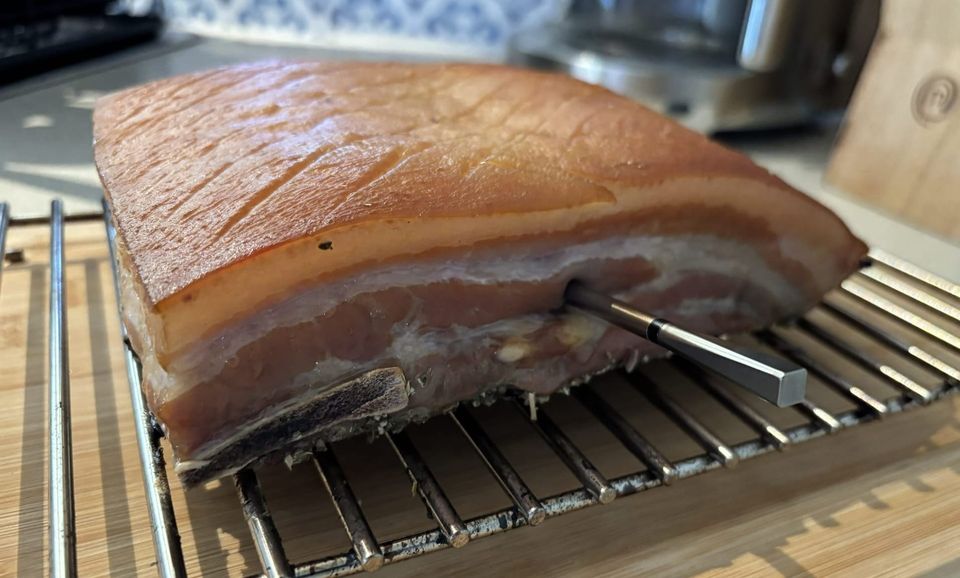
It's a short cook by smoking standards — three to four hours — and you're smoking it through to a target internal temperature rather than by the clock. I'll point you back to the recipe for the number, and this is where the Meater earns its place again: set the target, drop the probe in, and let it tell you when you're there rather than guessing and cutting in.
The thing that actually matters: the cut
If there's one lesson I've paid for in this cook, it's this — the bacon is only as good as the belly you start with, and "good belly" doesn't just mean expensive.
My first attempt was on a cut-price supermarket pork belly, and the quality wasn't there. So I moved to a proper butcher, which was the right call — except the cut I got was too close to the bone. That meant bits of bone and gristle running through the bottom, and every single rasher became a chore: trim, pick, trim again, before you could even cook or eat it. It takes the joy out of the payoff.
The fix is simple and it's worth saying out loud at the counter: buy a good butcher's-grade belly, and ask for it cut well clear of the bone. The final batch — proper belly, cut clean, no gristle to fight — was perfect. The rashers were superb: dense, smoky, properly bacon, the kind of thing you find excuses to cook.
The Honest Version
This is a genuinely forgiving cook. The brine does its work whether you're watching or not, the smoke is short and gentle, and short of badly over-smoking it there's not much you can do to ruin it. If you've been put off home-curing as some kind of dark art, it isn't — it's mostly patience.
The only real variable is the one you sort out before you cook a thing: the belly. Get a clean cut from a good butcher, dry it properly, smoke it over apple, and you'll have bacon you're quietly smug about for weeks. Three days, three hours of actual work, and a result that's hard to get wrong. The duck could learn a thing or two.
The Quiet Road covers regional Victoria, Tasmania, Italy, EV road trips, and the food and wine that connects it all. Subscribe to the newsletter for one recommendation every Friday.