Capo d'Orlando: Where Sicily Goes to the Beach
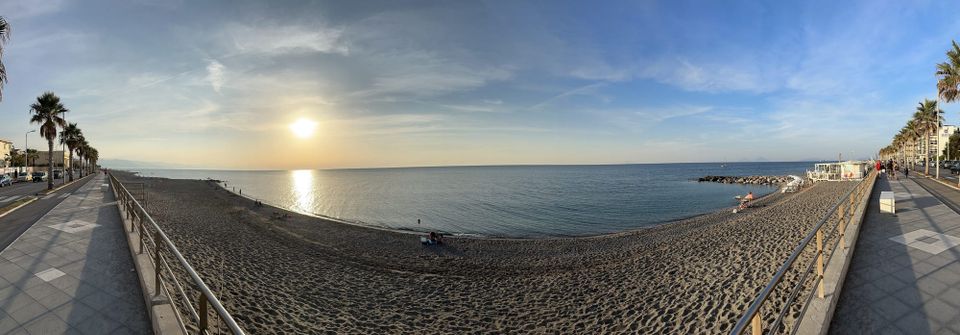
Every morning we crossed the road and swam.
That was the shape of the week. Out the door, one block down, across the front, and into water that was still warm in late September — clear enough that small fish came in to nibble at your toes while you stood there working out whether you were going to bother doing anything else with the day.
Capo d'Orlando appeared in my week-in-Sicily piece as a beach town on the north coast that barely shows up in English-language guides. That's still true, and it undersold it. We've spent proper time there, and it's one of the places in Sicily we go back to without needing a reason.
A resort town, but not for you
The thing to understand about Capo d'Orlando is who it's built for.
This is the beach town for the region — including the inland mountain towns, where people drive down for the water. It's a Sicilian resort, filled with Sicilian holidaymakers, and almost nothing about it is arranged around foreign visitors. The menus aren't in four languages. Nobody's handing out flyers. The town has a working centre with proper nightlife and a long, straight beach, and it goes about its business whether you're there or not.
That's the appeal, and it's also the trade-off. You get a quieter, cheaper, more relaxed week than you'd get on the east coast. If you want a place where the whole apparatus is set up for tourists, this isn't it — and there are plenty of towns in Sicily that are.
The beach and the front
The beach is a long run of sand along a straight stretch of coast, with a promenade behind it and cafes and bars set along the front.
In late September we didn't need to pay for a lounger — there was plenty of open sand, and we just took a towel down and swam. The water was still warm enough that nobody was hesitating on the way in, which is the real argument for shoulder season on this coast.
The best thing about the front is that it's genuinely part of the town rather than a separate strip bolted onto it. People are walking it in both directions all day. And at some point you will see somebody attempting to vacuum sand off their own footpath, a block from a beach, which is both entirely futile and completely reasonable, and which I think about more often than I expected to.
Dinner, then centro
Evenings run in two parts.
Dinner happens wherever you want it to — along the front, in the streets behind it, wherever you've booked. Then, once that's done, the crowd moves towards the town centre. The music and the bars are in the centro, and that's where the town ends up after dark. The promenade is a daytime and early-evening thing; the centre is the night.
Worth knowing if you're choosing where to stay. A block or two back from the beach can put you within walking distance of both, which is more useful than being right on the water.
Doria 66
The seafood restaurant on our street was Doria 66, and it's where we had one of the standout dinners of the stay — a seafood degustation menu, everything fresh, the kind of meal where you stop trying to identify individual highlights partway through.
Book it. We did, and I'd do the same again. This is the general rule for Capo d'Orlando in shoulder season: the town is quieter than in August, but anywhere popular still fills, and turning up hopefully at eight-thirty is not a plan.
Where to stay
We stayed a block back from the beach, in a large place next to the school — the same school that half our friend's extended family in the area remembers attending. Friendly hosts, easy stay, and I'd send someone to that stretch without hesitation.
That's the practical advice more than the specific address: a block or two behind the front, walkable to the sand in one direction and the centro in the other. Capo d'Orlando isn't big, and nothing on that side of town is a hike. There's a reasonable spread of places to stay in and around the town if you're booking ahead, which in September you should.
A base, not just a stop
Capo d'Orlando earns its place because of what you can reach from it.
The marina runs boats out to the Aeolians — Salina and the smaller islands, and the evening run to watch Stromboli. We did two days out of that harbour, which I've written up separately in the Aeolian Islands piece; here, the marina is simply the reason the town works as a base rather than a night's stopover.
There's also a train station on the Messina–Palermo line, which is more useful than it sounds. It means you can arrive and leave without a car (even from Rome!), and it puts both ends of the north coast within reach for a day.
The honest limitation is Etna. It's too far for the organised day trips that collect you from your accommodation — the pickup radius doesn't reach this far along the north west coast. We drove ourselves, which was fine, but if a guided Etna day is a fixed item on your list, you'd want to base somewhere closer for that leg between Messina and Catania rather than expecting Capo d'Orlando to cover it.
When to go
We found mid-to-late September is the sweet spot, and it's when we were there.
The crowds have thinned out but the season hasn't ended. The water is still warm. You don't need to pay for a beach spot. The town is winding down rather than shut down — the bars are still going, the restaurants are still busy enough to need booking.
We'll tell you what August is like after our stay this year!
The Honest Versi
What makes Capo d'Orlando worth a week rather than a night is the combination: a beach you can actually use, a marina that gets you to the Aeolians, a train line that delivers you from Rome and gets you along the coast, and a town that's pleasant to be in when you're not doing either of those things.
If you want a base on the north coast that isn't organised around visitors, this is the one I'd pick.
This article contains affiliate links — if you book or buy through them, The Quiet Road may earn a small commission at no extra cost to you. We only recommend places and experiences we've personally tried. See our privacy policy for details.
The Quiet Road covers regional Victoria, Tasmania, Italy, EV road trips, and the food and wine that connects it all. Subscribe to the newsletter for one recommendation every Friday.