Smoke, a Wireless Thermometer, and the BBQ Setup That Changed How I Cook
I'm going to tell you something that will sound like an ad but isn't: the best recipe resource I've found for barbecue cooking is Weber's own website. I know. But the recipes on Weber's website are genuinely good — well-tested, clearly written, and designed for the equipment you actually own rather than the equipment you wish you owned. I've cooked many of their recipes and they consistently deliver.
That's the first thing nobody told me about BBQ: the manufacturers know their gear better than the food bloggers do.
Here's the second thing: you don't need a $5,000 setup to cook food that makes people go quiet and eat with their eyes closed. You need two things — smoke and a good thermometer. Let me explain.
My Setup
I own two Weber BBQs: an electric Weber Pulse and a standard gas Weber Q.
The Pulse is the versatile one. It's electric, so it works anywhere you've got a power outlet — our inner-city apartment balcony, picnics where there's access to power, or the cottage in Daylesford. We used to travel with a Weber Baby Q for the caravan, but found it easier to take the Pulse and use electric wherever we had power. The Baby Q is gone now.
The Weber Q is the workhorse at the Daylesford cottage. More space, more heat, and critically, more room for smoking.
Neither of these is a dedicated smoker. Neither is a kamado or a Big Green Egg (more on that later). But both of them can produce genuinely impressive smoked food with the right technique and a couple of cheap accessories.
How I Smoke on a Weber
I use Weber smoking boxes — I have two — filled with Weber wood chips. The technique that works best for me after a lot of experimentation:
Put a dry layer of wood chips on the bottom of the smoking box first. Then add the recommended handfuls of pre-soaked chips on top. The dry layer ignites faster and gets the smoke going while the wet chips smoulder slowly behind them. This gives you a quicker, stronger, more consistent smoke than if you just use soaked chips alone.
Place both smoking boxes over the heat source, close the lid, and let the temperature build before you put the meat on. Patience at this stage pays off — you want a thin blue smoke, not billowing white clouds.
One honest caveat: smoking on an apartment balcony is almost a non-starter if you have close neighbours. The smoke is real and it travels. Our place in Daylesford has the space and location for it — that's where the serious smoking happens. In the city, I save it for days when the wind is right and the neighbours are out.
The Secret Weapon: Meater Pro
The single best purchase I've made for barbecue cooking is the Meater Pro wireless meat thermometer. It changed how I cook more than any recipe book, any technique, or any piece of equipment.
The Meater is a wireless probe that pairs with your smartphone or smartwatch. It gives you a precise, real-time reading of both the internal temperature of your meat and the ambient temperature inside your cooker. It tells you when to get ready, when to take the meat off the flame, when to rest, and when it’s ready — no guesswork, no cutting into the meat to check, no hovering over the BBQ for three hours.
The killer feature: because it's completely wireless, you can use it on a rotisserie without a wire snagging after one turn of the rod. The Meater just works.
It connects over Bluetooth and has an extended range via the charging block, so you can monitor your cook from inside the house. During a low-and-slow session, I'll set it up and check my phone from the couch. When it's time to act, your device buzzes. That's it.
Genuinely — if you buy one thing after reading this article, make it the Meater.
What I Cook: The Go-To Recipes
Chipotle Chicken Quesadillas
This is my never-fail crowd-pleaser, straight from the Weber recipe site: Chipotle Chicken Quesadillas.
It's deceptively simple — spiced chicken cooked on the grill, sliced, then loaded into tortillas with cheese and whatever else you want to add. The smoky char on the chicken makes all the difference. I've cooked these for groups of every size and they've never disappointed. They're also fast, which makes them ideal for the weekend lunch that turns into an afternoon without any forward planning.
Duck with Smoked Ginger-Peach Chutney
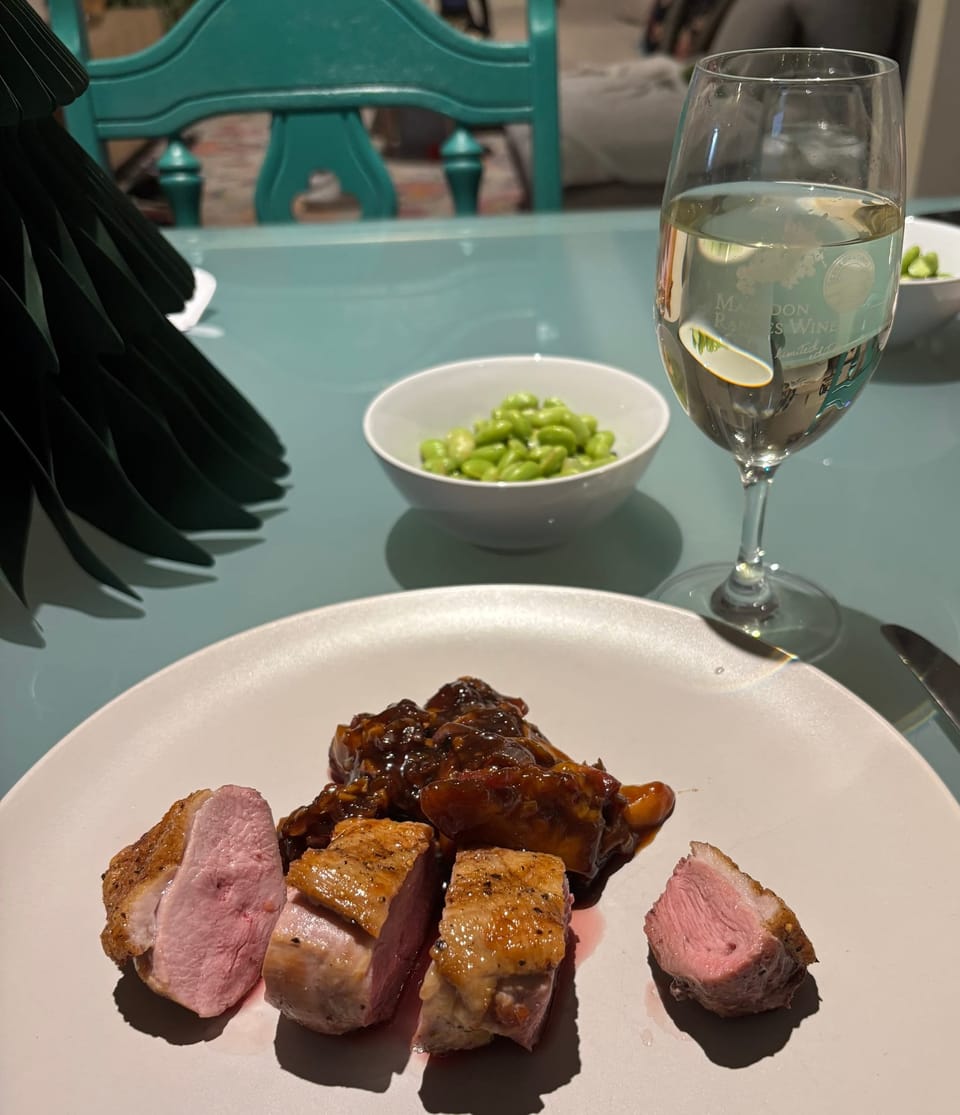
This is the ambitious one — adapted from one of my Weber recipe books. The chutney is an absolute crowd-pleaser — sweet, smoky, with a ginger kick that cuts through the richness of the duck. Even if you mess up the duck — which, I'll be honest, is frustratingly easy to do — the chutney carries the meal, and then some. I'll do a full step-by-step on this one in a future article.
Duck is unforgiving. The window between undercooked and overdone is narrow, and the fat renders at its own pace regardless of your plans. This is where the Meater earns its keep. Internal temperature monitoring takes the guesswork out, and the difference between a perfectly cooked duck breast and one you're apologising for is often just a few degrees.
Smoked Pork Belly Bacon
This is the project cook — another one from my Weber recipe books, and the one you do on a Saturday morning in Daylesford when you've got nowhere to be. Curing and smoking your own pork belly bacon takes time and a bit of setup, but the result is incomparably better than anything you'll buy at a supermarket. Thick-cut, smoky, with a depth of flavour that commercial bacon can't approach. I'll write up the full process in a dedicated piece — it deserves one.
It's also an impressive thing to serve at breakfast the next morning without saying too much about it. Just put it on the plate and wait for someone to ask what's different.
Simple Sausages, Done Properly
Sometimes the best thing you can cook on a barbecue is the simplest. Quality butcher's sausages — a beef, tomato and basil, or a lamb and honey from somewhere like Daylesford Meat Co when we're at the cottage, or one of the butchers at the South Melbourne Market when we're in the city — cooked perfectly on the Weber with the lid down.
The lid is the key. Most people cook sausages with the lid up, blasting them on high heat until the skin splits and the inside is still pink. Close the lid, drop the temperature, and give them time. The skin crisps evenly, the fat renders properly, and the inside cooks through without drama. Add a smoking box and you've turned a $15 packet of sausages into something that tastes like it came from a proper smokehouse.
What I Drink With It
BBQ and wine is a better pairing than most people give it credit for. A medium-bodied shiraz with peppery notes — something from the Macedon Ranges or Heathcote — handles smoke beautifully. For the chicken quesadillas, I'll often open a lighter red that can be slightly chilled. Something white and sweeter like the Bendigo Reisling from Passing Clouds pairs perfectly with duck.
For a low-and-slow session that stretches through the afternoon, I'll start with beer (something pale and crisp) and move to wine with the meal itself. The cook is as much about the hours spent around the barbecue as it is about the food, and the drinks should match that pace.
The Big Green Egg Dream
I don't own a Big Green Egg yet. I will.
The Big Green Egg is a ceramic kamado-style cooker fuelled only by lump charcoal. It holds temperature with extraordinary precision, can smoke at low temperatures for hours, sear at extreme heat, bake bread, roast a whole chicken, and do things with ribs that my Weber smoking boxes can only approximate.
What I have — two Webers with smoking boxes — is adequate and has served me well. But the gap between "adequate smoke" and "proper kamado smoke" is real, and every time I use the smoking boxes I'm aware of it. The Big Green Egg is where I'm heading, and the Daylesford cottage is where it'll live.
When I get it, you'll be the first to know. And the first recipe will almost certainly be a low-and-slow pork shoulder that I've been waiting years to cook properly.
Getting Started
If you're reading this and you've never smoked on a Weber, here's what you need:
- A Weber with a lid. Any model. Gas or electric. The lid is what makes it a smoker rather than just a grill.
- Two Weber smoking boxes. About $30 each. They sit on the grill plate over the heat source.
- Weber wood chips. Cherry or apple for poultry — something light that doesn't overpower the bird. Apple is the obvious choice for ham and bacon. Hickory adds a nice depth and blends well with the fruitwoods. Start there and experiment — a bag lasts a long time.
- A Meater Pro thermometer. About $200. The single best investment you'll make.
That's it. Total outlay, assuming you already own the Weber: under $300. And the first time you pull a piece of smoked chicken off the grill and see your guests go quiet, you'll wonder why you didn't do this years ago.
The Quiet Road covers regional Victoria, Tasmania, Italy, EV road trips, and the food and wine that connects it all. Subscribe to the newsletter for one recommendation every Friday.