Six EVs I've Actually Driven: Honest Notes from an Australian Owner
Over the past couple of years, I've driven six different electric vehicles on the roads between Melbourne and regional Victoria. Not as a car journalist doing a curated press launch on freshly swept tarmac — as a real person, driving to Daylesford on a Friday afternoon, charging overnight at home, dealing with whatever gremlins showed up on a cold Tuesday morning.
Every EV review you read online is written by someone who had the car for a week at most. Some of these I lived with for months. You notice different things after month three than you do after day three.
Here's what I learned, car by car, and the deal-breaker rule I didn't know I had until I'd driven all six.
The Deal-Breaker Rule
After six cars, I've worked out what actually matters to me — and it's simpler than I expected.
If a car is expensive, lacks range, and lacks space, it doesn't matter how good the features are. You can have the best app and heads up displays in the world, but if you're doing range arithmetic every time you drive to Daylesford, or you can't fit the weekend bags in the boot, the car has failed at the basics.
That rule eliminated two of the six almost immediately. Here's how they all stacked up.
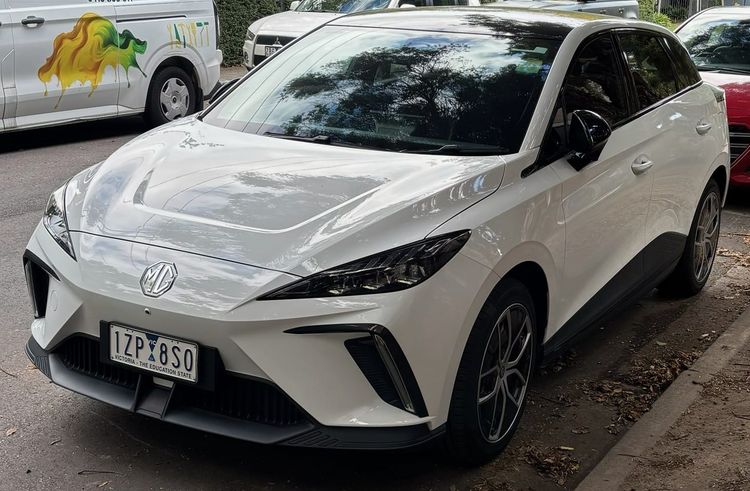
MG S5 EV (long range) — The One I'd Have Kept
I'm putting this first because it surprised me the most. The MG S5 EV was the cheapest car in the lineup by a comfortable margin, and it was the one I drove for six months — longer than any of the others.
It was better than the price suggested. Quite a bit better, actually. The interior was larger than expected, the range was long enough for everything I needed, and the reversing camera was good. It was a genuinely fun car to drive. At the price point, the features and the overall package were a bargain.
Was it perfect? No. The settings had to be manually reloaded every single time you opened the car, which was annoying. The build quality wasn't going to win any awards. But for the money, I'd have happily kept driving it.
I only handed it back because the arrangement ran out, not because I wanted to. That tells you everything.
The verdict: Best value in the lineup by a mile. If you want an EV and you don't want to spend BMW or Tesla money, this is the one to look at seriously; if you're happy with the implications of driving a Chinese-brand car.
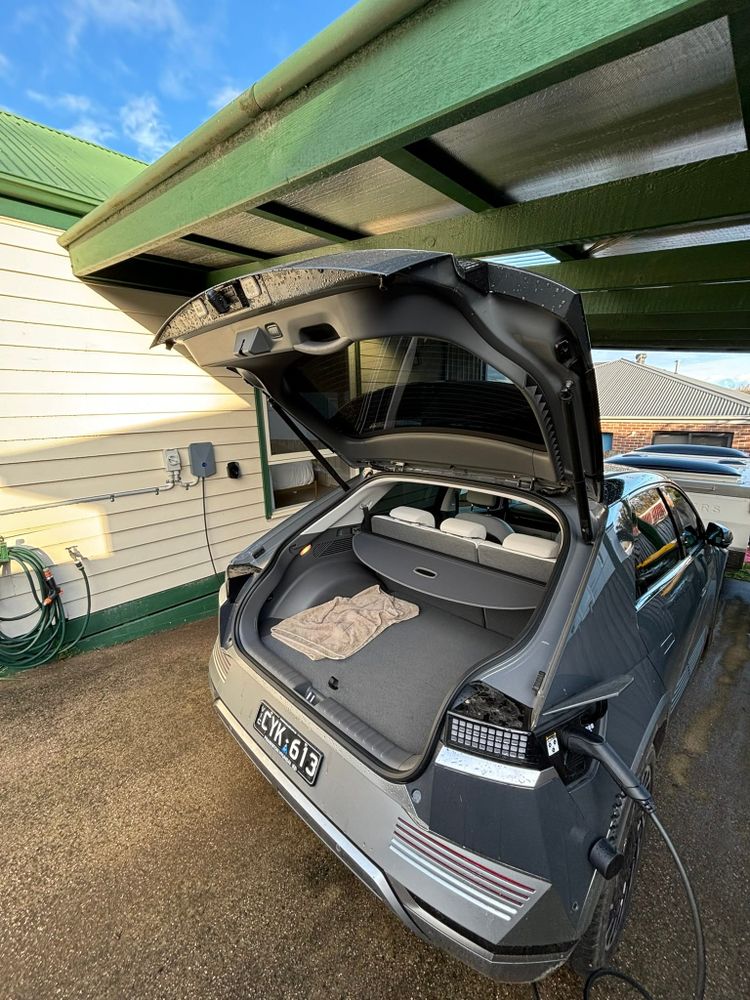
Hyundai Ioniq 5 (Dynamiq model) — The Practical Choice
The Ioniq 5 is not an "exciting" car. I should just say that upfront. It doesn't have the sportiness of the BMW, the tech polish of the Tesla, or frankly any personality at all. It drives a bit like a bus and it looks like a concept car that accidentally went into production.
But it might be the one I'd recommend to most people.
The range is very good — quoted at 481 kilometres, and the actual range runs closer to the quoted figure than the BMW ever did. The space is ... spacious. Hyundai designed this from the ground up as an electric car, and it shows — the floor is almost completely flat and the centre console adjustable (!), which means the interior feels like a small living room rather than a car with a transmission tunnel down the middle.
The cross-traffic collision alert when reversing is the best of any car I tested. It picks up cars from a long way off and rumbles the steering wheel to get your attention (without feeling like you've just scraped the undercarriage on a gutter — here's looking at you, MG). Genuinely useful.
The downsides: when we drove it in 2004, there was no app connectivity on the Dynamiq model, which means you can't lock or unlock it remotely, see the charge level, or pre-warm it on a cold morning from your phone (one of the best features in Melbourne and regional Victoria in winter). You can program pre-conditioning from inside the car the day before, but that's clunky. It also doesn't creep forward on its own when you lift the brake, which makes parking genuinely nerve-wracking, particularly in an apartment garage. You're trying to inch forward by centimetres but the car only moves if you touch the accelerator — and the pickup is less precise than the BMW. I can see someone easily crashing into a wall trying to park.
Oh, and ours came with all-white leather seats. The rep who handed it over cheerfully wished me "good luck keeping it clean." He was right to.
The verdict: Not exciting. Very practical. If range and space are your priorities, it's the smart choice.
Tesla Model Y Long Range — The Best Drive, But ...
The Tesla drives beautifully. There's no getting around it — it's the smoothest, quietest, most comfortable car of the six. The space is the best of the lot, with a boot, a frunk, and enough room for that my aftermarket floor coverings actually fit properly for once. The "easy exit" feature that moves the seat back when you stop is a small touch that makes you wonder why every car doesn't do this.
The app is excellent. Charging, pre-conditioning, dog mode for air conditioning — it's miles ahead of everything except the BMW.
So why isn't it number one?
The cruise control is almost unusable. It brakes suddenly and without warning when it thinks you're going to hit something you're clearly not going to hit — like a car stopped on the shoulder of the freeway, or a mosquito passing briefly past the headlights. It nearly gives you whiplash and creates genuinely dangerous situations for the car behind you. After several scares along the Western Freeway between Bacchus Marsh and Ballan, I stopped using it entirely.
There's no heads-up display and no 360-degree parking camera, which makes it more awkward to park than the others. The built-in navigation is terrible — bizarre routing, slow to update. Music options were hard to figure out. And Tesla won't do V2L or V2G (vehicle-to-load or vehicle-to-grid), and seems unlikely to add them.
Charging at third-party stations like BP was easy. The Tesla Superchargers at our local Coles, on the other hand, were in an almost unusable position right near the entry and exit gates that needed the deft ability to conduct a 100-point turn while a line of cars waits impatiently to exit (or enter) the carpark.
The verdict: The easiest car to drive when in full control. But the cruise control is a deal-breaker for highway use, and the parking situation is frustrating. I'd still choose the Ioniq 5 for everyday life.
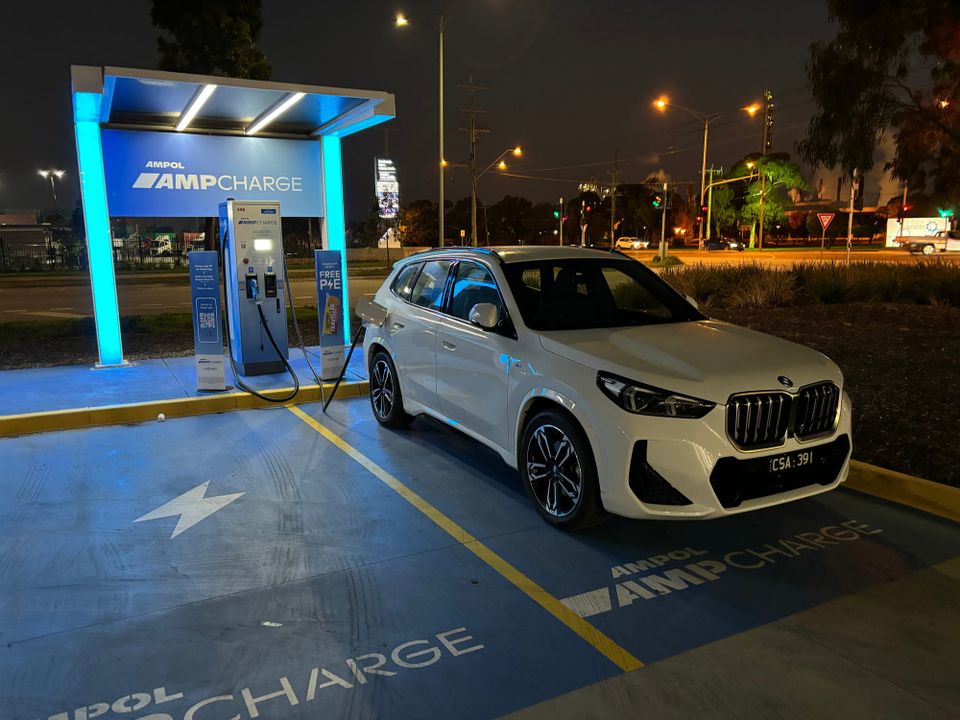
BMW iX1 — Fun, But the Numbers Don't Work
The BMW was the most fun to drive. Sporty, responsive, great vision — it sits at a lower, sedan-style height that gives it a more connected feel than the SUV-style EVs. The heads up display on the windscreen is fantastic. The app is excellent, with remote lock/unlock, charge monitoring, remote air conditioning, and the ability to differentiate between two drivers.
Once you get the hang of its features, it's a very easy and enjoyable car. BMW even offer a free two-hour "genius" handover session to walk you through everything, which tells you something about the learning curve.
But the range killed it for us. Quoted at 438 kilometres, the actual range at the recommended 80% long-term charge was closer to 280. Even at 100%, you're looking at around 350 in the real world. That's tight for a Melbourne-to-Daylesford weekend where you also want to drive around the region without constantly worrying about the battery.
We also hit charging gremlins. The car's proximity auto-unlock feature — where it unlocks when you walk near it — would terminate charging every time it triggered. If you're parked directly below your apartment or next to your living room, that's a problem. And when our home charger reduced its output to account for other household loads like the dryer, the BMW terminated the charge entirely. The only fix was going outside, physically unplugging the cable, and plugging it back in. This settled down after the first day and some setting changes, but the initial experience was frustrating.
The cruise control had its own issues — it's very easy to let the adaptive systems do the driving when they aren't ready to handle situations like cars unexpectedly pulling out into your lane at 110 km/h.
The verdict: A lot of fun. But expensive, short on range, and short on space. That's my deal-breaker combination. I am genuinely looking forward to the iX3 Neue Klasse variants (reportedly more than 800km range) but they won't be cheap.
Volvo XC40 Recharge Ultimate — The Disappointment
This was the one we expected to love. Volvo, top of the range, everything included. We genuinely thought it would be the keeper.
It wasn't.
The steering and acceleration felt loose and flighty — not the planted, confident feel you expect from a Volvo. The cruise control didn't slow the car down to meet the set speed on downhill sections — it just coasted like a non-electric car and let the speed build, easily creeping to five or more over the limit. For a car that costs what this one costs, that's not acceptable for Victorian freeway driving.
The sunroof sounds appealing in the brochure. In practice, it wasn't much fun — and we've since seen friends whose sunroofs have developed strange cracking patterns for no reason, which doesn't inspire confidence.
After driving all the others, the Volvo just felt middle. Not bad at anything in particular, but not good enough at anything to justify being the most expensive car in the lineup.
The verdict: The biggest letdown. We expected the best and got something less than that at a premium price.
BYD Atto 3 — The One I Can't Recommend
I wanted to like the BYD. It's cheap, it's Chinese-made, it's disrupting the market, and there's a good story in being the budget option that punches above its weight. Unfortunately, that wasn't my experience.
We had it for a long weekend and drove it to Daylesford. It felt cheap — tinny, lightweight in a way that didn't inspire confidence. The interior has an unusual design language that I can only describe as a disco party vibe. If that's your thing, you'll love it. It's not my thing.
More importantly, it was scary on the Western Freeway. The drive felt light, and at 110 km/h in crosswinds and passing trucks, I didn't feel planted or safe. For a car you're supposed to take on road trips, that's a serious problem.
On the positive side, it has a blade battery that BYD says is safe to routinely charge to 100%, which is unusual — most EVs recommend stopping at 80% for long-term battery health. The range is on the shorter end, so that 100% option matters. And with five grown men driving from Daylesford to Woodend it was fine.
But I wouldn't recommend it. The MG is a significantly better car.
The verdict: Cheap, but it feels it. If budget is your primary concern, look at the MG instead.
The Ranking
After driving all six, here's where they land for me:
- MG S5 EV — Best value. The one we'd have kept.
- Hyundai Ioniq 5 — Best all-rounder. The sensible choice.
- Tesla Model Y — Best to drive. Let down by unusable cruise control.
- BMW iX1 — Most fun. But the range and space aren't enough.
- Volvo XC40 Recharge — Most disappointing. Expected the best, got average.
- BYD Atto 3 — Can't recommend. The MG does everything better.
Your priorities will be different from mine. If you don't use cruise control and you love tech, the Tesla is hard to beat. If you want something sporty and you have overnight charging sorted, the BMW is a lot of fun. But if you want a car that simply works for weekend road trips in regional Victoria — good range, enough space, no dramas — the Ioniq 5 or the MG are where I have and will continue to put my money.
A Note on Charging
- To an extent, the car matters less than the charging setup. If you have a Level 2 charger at home — we do, and our Airbnb guests in Daylesford use it too — range anxiety essentially disappears. You plug in at night, wake up full, and drive wherever you want.
Public charging infrastructure in regional Victoria is improving but still patchy. Some chargers work reliably, some don't. I've written a separate guide on the Melbourne to Daylesford EV charging route that covers exactly which stops are worth relying on.
The EV transition isn't about having a perfect car. It's about having one that's good enough — and all six of these were good enough to make it to Daylesford and back without drama. The question is which one you'll enjoy living with for the other 360 days of the year.
The Quiet Road covers regional Victoria, Tasmania, Italy, EV road trips, and the food and wine that connects it all. Subscribe to the newsletter for one recommendation every Friday.